Some excellent work in this unit and a well-though through and well produced documentary.
You have comprehensively explained issues relating to factual television programmes with elucidated examples and consistently using subject terminology correctly.
You have comprehensively explained codes and conventions of factual programmes with elucidated examples and consistently using subject terminology correctly.
You were able to plan and research a factual programme for television to a quality that reflects near-professional standards, showing creativity and flair and working independently to professional expectations.
You have produced a factual programme for television to a technical quality that reflects near-professional standards, showing creativity and flair and working independently to professional expectations.
An excellent springboard for next years work.
Showing posts with label D. Assignment 3: 3MW. Show all posts
Showing posts with label D. Assignment 3: 3MW. Show all posts
Friday, 1 July 2016

An Introduction to the News
Part 1
 I watched the BBC Look East Evening News that was broadcast
on the 30th of June 2016 at 6.30pm.
I watched the BBC Look East Evening News that was broadcast
on the 30th of June 2016 at 6.30pm. The stories that were covered are listed below in chronological order:
East Anglian Devolution
·
Recruitment Prices of Teachers
·
The Sentence Dealt to Kevin Toye for the
Manslaughter of his son
·
Bernard Matthews changing hands
·
Gala Dinner
·
Battle of the Somme Remembrance Services
·
Brexit Effects on Local Tourism
·
British Art Show Coming to Norwich
 The opening sequence included a quick overview of the main story
lines and iconic scenes from the local area (East Anglia) including the pier
and farming. I think that an overview was used in the opening sequence so that
the audience’s interest is engaged from the very start and could be held
throughout the episode and the iconic scenes were used to reinforce that the
segment was about the local area and news that affects the people that live
there.
The opening sequence included a quick overview of the main story
lines and iconic scenes from the local area (East Anglia) including the pier
and farming. I think that an overview was used in the opening sequence so that
the audience’s interest is engaged from the very start and could be held
throughout the episode and the iconic scenes were used to reinforce that the
segment was about the local area and news that affects the people that live
there.
Part 2

The main two newsreaders were Susie Flower-Watt (picture on the left), female aged
47, and David Whiteley (picture below on the right), male aged 39. Other news readers included Andrew
Sinclair (male, political correspondent), Alex Dunlop (male), Richard Bond
(male, business correspondent), Gareth George (male), Shaun Peel (male), Mike
Liggins (male), and Alex Dolan (female, weather reporter).

The role of a newsreader is to present a storyline to the public informatively so that everyone in the audience is able to understand. Some stories may allow them to give an opinion, however usually the only opinions that are mentioned throughout the story are from the people that are interviewed.
Every news reader must have effective communication skills, be enthusiastic about everything they have to present where they disagree with the story or not, and have strong verbal skills in whatever language they are presenting in.
Part 3

The term “ordering” when used in the news means the order in
which each story appears in the news bulletin and the list of stories compiled
together is called a “running order”. The lead story is always the story which
is shown first, it is selected as the lead by how important the story is to the
audience. Other stories are shorter than the lead and are presented in order of
interest, the stories closer to the end of the broadcast are usually of similar
themes and can often be grouped together in a “news round-up”.
It is important
to think and act quickly in the news as things happen in real time, so if
something happens that is more important, the running order must change
straight away to fit around the new more important headline. A slow news day is
a day when nothing that can be considered high priority or important so trivial
stories are presented to fill the gaps.
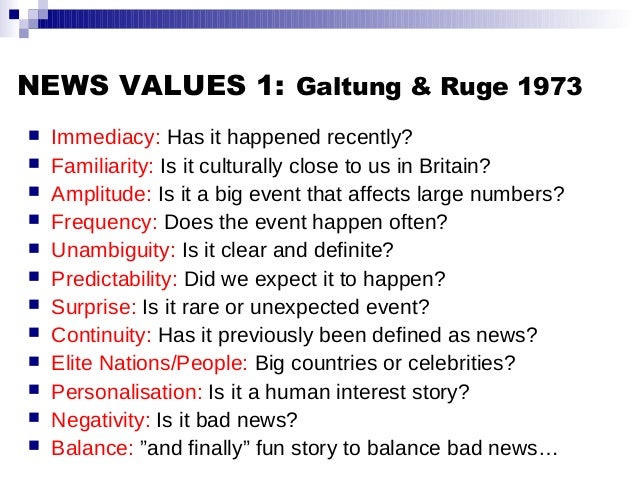
The last story is usually a “lighter story” and is called the “and finally”. It usually ends the news on a more positive, cheery note. The term “news values” means the importance the story has and how much attention it gathered from the audience. Galting and Ruge is a list of news values that nearly every story can be categorised as.
The last story is usually a “lighter story” and is called the “and finally”. It usually ends the news on a more positive, cheery note. The term “news values” means the importance the story has and how much attention it gathered from the audience. Galting and Ruge is a list of news values that nearly every story can be categorised as.

Looking back at the news bulletin I watched the first story
about the East Anglian Devolution can be categorised as both immediacy and
negativity as it was the lead story in the round up and it included the fact
that there was a loss of funding. The second story about the recruitment prices
of teachers would fit under personalisation as it affects most people and their
education. I think the story about Kevin Toye’s sentence for killing his son
would come under familiarity but only because he was in fact from Norfolk so
the devastation of the young boy’s death feels more close to home. The story
about Bernard Matthew’s changing hands may fit under continuity as during the
story it was mentioned that the company hadn’t been doing as well since the
outbreak of the bird flu a few years ago. The story about the Gala Dinner will
definitely be associated with elite nations/people as the Duke and Duchess of
Cambridge were involved. Amplitude would be the category that the story about
the Battle of the Somme remembrance services over a million men died during the
battle and people nationwide are taking part in remembering their horrific
deaths. I think that the Brexit
effecting local tourism would come under unambiguity as some people in the
report were saying that it was going to have a positive effect and others were
saying it was going to have a negative effect. And finally, the balance story
will most definitely be the story about the British Art Show that was presented
at the end.
Part 4
Bias through selection and omission means whether or not a
particular story is shown and if it is how it is angled to give the audience a
specific view. For example, if the news reported a story about one of the MPs
that are now running for Prime Minister and they show them pushing past the
camera saying “no comment” this could portray them as an aggressive person and
give the audience a negative view on them, this could affect their campaign.
However, if they just show a clip of them walking with a smile on their face
giving the camera a wave then the audience would see them as a friendly person
giving them a positive view on them.

The running order can also be affected by bias, the stories
that are broadcast at the start are more important than the stories closer to
the end. The running order in the Look East Broadcast that I watched had the
East Anglian Devolution as the lead story making it the most important, this is
usually based on the editor’s opinion and will affect the audience’s opinion.
 The headline of the news story (this is usually used in the
opening sequence of the broadcast) sums up the story and reflects what it is
about or the feeling people have about the topic. This is a form of bias as the
person who wrote the story would have chosen how to portray the piece. On the
BBC website there is a story called “where did it all go wrong for Johnson?”
this sums up the story, portrays it to be negative and also sticks the question
into the audience’s head so that they will be curious enough to watch it.
The headline of the news story (this is usually used in the
opening sequence of the broadcast) sums up the story and reflects what it is
about or the feeling people have about the topic. This is a form of bias as the
person who wrote the story would have chosen how to portray the piece. On the
BBC website there is a story called “where did it all go wrong for Johnson?”
this sums up the story, portrays it to be negative and also sticks the question
into the audience’s head so that they will be curious enough to watch it.
The photos and camera angles can form bias on a story and
can have a strong influence on the feel/opinion made. For example, recently a
train broke down in the Eurotunnel and the photo used reminds the audience of a
horror/thriller film scene; it shows a line of people walking through the
tunnels with only the lights on the side of the tunnel to guide them through.
 The news normally always introduces whoever is shown on
screen using their name and a small description (usually a few words), whoever
writes this description can affect how the audience makes their opinion of them
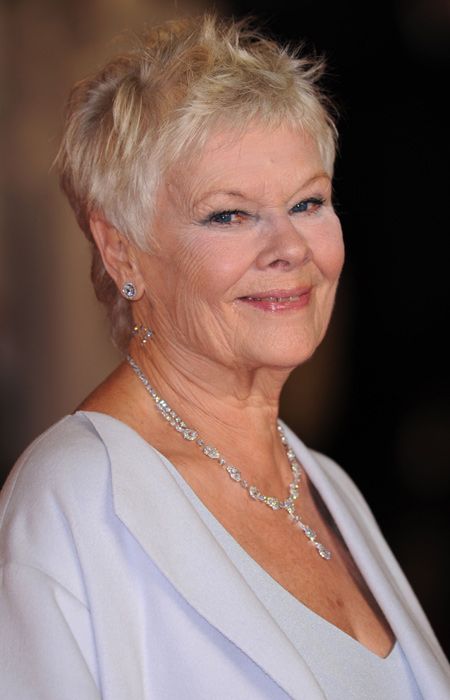
through bias about the person. For example, in a news article about Judi Dench’s
tattoo she is called “Dame Judi Dench”, if the audience doesn’t know anything about
her they’ll know she has some significant importance as she was awarded the
title of “Dame” by the Queen.
The news normally always introduces whoever is shown on
screen using their name and a small description (usually a few words), whoever
writes this description can affect how the audience makes their opinion of them
through bias about the person. For example, in a news article about Judi Dench’s
tattoo she is called “Dame Judi Dench”, if the audience doesn’t know anything about
her they’ll know she has some significant importance as she was awarded the
title of “Dame” by the Queen.
Another bias can take hold through the word choice used throughout
the story, either giving the topic a positive or negative connotation. For
example, a news story on the BBC website about how the EU Referendum might
affect science wrote “a leading scientist has said UK science will suffer
unless any post-

Picture Sources:



Thursday, 30 June 2016
Mindmap and Proposal
I would like to make a documentary about Gorleston; more
specifically what makes Gorleston a beautiful place.
It would be in the reflexive documentary style as it would be more about showing rather than telling and I feel this style is the best for this. I can focus more on what the shot includes rather than who’s in it talking about what and when.
The documentary would be aimed at people aged 16 to 24 and fit into the A - C1 as well and E demographic. The target audience would also fit into the explorer psychographic. By producing this documentary I aim to change the minds of people who don’t like it here in Gorleston; show them that it’s actually a beautiful place to be and that they only need to open their eyes to see what’s in front of them.
As the documentary is based on Gorleston I will only need to film in Gorleston therefore I won’t need any transport.
I would like to use my dog and siblings in the documentary but I won’t actually need any crew as I will only be using one camera and won’t be recording any sound.
I’d like to use 50mm 1.8 prime lens to film my whole documentary as I will be able to capture more artistic shots with a sharper quality. I will not need to buy any equipment as I can borrow the lens from the college’s AV room.
The only prop I would need to buy would be some chips and nuggets from the café at the beach to show the local foods. This will only cost a few pounds so I would propose a budget of £5.
It would be in the reflexive documentary style as it would be more about showing rather than telling and I feel this style is the best for this. I can focus more on what the shot includes rather than who’s in it talking about what and when.
The documentary would be aimed at people aged 16 to 24 and fit into the A - C1 as well and E demographic. The target audience would also fit into the explorer psychographic. By producing this documentary I aim to change the minds of people who don’t like it here in Gorleston; show them that it’s actually a beautiful place to be and that they only need to open their eyes to see what’s in front of them.
As the documentary is based on Gorleston I will only need to film in Gorleston therefore I won’t need any transport.
I would like to use my dog and siblings in the documentary but I won’t actually need any crew as I will only be using one camera and won’t be recording any sound.
I’d like to use 50mm 1.8 prime lens to film my whole documentary as I will be able to capture more artistic shots with a sharper quality. I will not need to buy any equipment as I can borrow the lens from the college’s AV room.
The only prop I would need to buy would be some chips and nuggets from the café at the beach to show the local foods. This will only cost a few pounds so I would propose a budget of £5.
Secondary Research
Secondary Research
The above news articles from the Easton Daily Press are
about Gorleston, most of which include different element of valuable history
about the local area.
This project is about making people aware of the potential
their hometown has, this is a similar aim to how I want to direct my own
documentary. Opening people’s eyes to what is in front of them is important and
lots more people should get involved.
This projects is about acknowledging normal people (meaning
those who aren’t famous) doing extraordinary things to help others, not for
profit but out of the kindness of their hearts. The stories are shot in an
expository documentary style with beautiful shots throughout of different
aspects of the person’s life.
Filming in
Public
Filming in
public requires permission from the local authority or council, whereas if
filming was to take place on someone’s land/property permission from the owner
would need to be given. However, to show the outside of a place (including a
company name) along with passers-by permission is not required.
If during
filming any firearms, replica firearms, explosives, police officer uniforms,
police vehicles permission from the local police is required. It is also
required by the police and the Highways Department of the local authority if
any filming is to take place on a public road.
Libel and
Defamation
“Defamation
is an area of law that provides a civil remedy when someone’s words end up
causing harm to your reputation or your livelihood. Libel is a written or
published defamatory statement.” (http://www.nolo.com/legal-encyclopedia/defamation-slander-libel)
I do not think I need to consider libel or defamation when producing my documentary as my documentary I have proposed is about showing people who don’t particularly like Gorleston that it’s a beautiful place. However, if I was making a more controversial documentary then I may have to consider libel or defamation.
I do not think I need to consider libel or defamation when producing my documentary as my documentary I have proposed is about showing people who don’t particularly like Gorleston that it’s a beautiful place. However, if I was making a more controversial documentary then I may have to consider libel or defamation.
Ofcom
Broadcasting Code
In making
my documentary I believe that I am not risking infringement (“an act that
disregards an agreement or a right” - https://www.vocabulary.com/dictionary/infringement) of the Ofcom Broadcasting Code as
it will not include any offensive/abuse content of any sort, anyone involved
will be given a talent release form to sign (for minors their parents will be
given the form), e.c.t. I plan for my documentary to only be about showing
beauty in the local area, nothing else therefore there is no risk.
Sunday, 26 June 2016
Primary Research
I asked ten people to answer a short questionnaire so I could
gather some primary research about Gorleston and what people really think of
it.
Eight out of the ten people that I asked said that they would be interested in watching a documentary about the local area whether they like it or not. Four out of the ten people I asked said that they don’t actually like Gorleston, these four people are the people I want to aim my documentary at. I want it to change their minds and open their eyes to what is here.
Eight out of the ten people that I asked said that they would be interested in watching a documentary about the local area whether they like it or not. Four out of the ten people I asked said that they don’t actually like Gorleston, these four people are the people I want to aim my documentary at. I want it to change their minds and open their eyes to what is here.
Monday, 16 May 2016
Tuesday, 10 May 2016
3 Minute Wonder Research
Sawyer Hartman does a series of reflexive documentaries on
YouTube called “Thru My Eyes”. He shows beautiful places that he explores
through the eye of a camera lens for his follows to enjoy along with him. This
style of documentary is captivating in each of its shot types.
Joshua Tree, CA:
Joshua Tree, CA:
Joshua Tree, CA is made up of mostly slow motion shots of specific beauties. I like how the smallest details have been captures, for example the markings on the dog’s tongue and the grooves in the rocks. The cinematography of every single second has been thought out and shot to a high quality which allows the audience to fully appreciate the magnificence of nature.
Santa Barbara, CA:
I like this one because the editing is done to the beats of the music, the shots change quite but they all have enough screen time. One of my favourite things about this one is that he uses different lenses to improve certain shots. For example, he used a fish eye lens to capture the trees close to the start of the piece.
The Girl of Your Dreams:
I think this one may be my favourite out of all of Sawyer’s
series as even though the whole video is about a beautiful woman it also captures
beauties around Malibu. He has captured things that people usually take for
granted and shone a massive well deserved light on them. The slow motion of the
piece gives the shots a sort of breath taking effect on the audience.


 In all of Sawyer’s documentaries he enhances the colours in
the shots to make them more vibrant. This is common when he has shots of
flowers, animals and sun sets. Also, most of his pieces are made up mostly of
slow motion shots. His cuts are usually quicker
and a little jumpy when the
drum beats of the song used are more prominent.
In all of Sawyer’s documentaries he enhances the colours in
the shots to make them more vibrant. This is common when he has shots of
flowers, animals and sun sets. Also, most of his pieces are made up mostly of
slow motion shots. His cuts are usually quicker
and a little jumpy when the
drum beats of the song used are more prominent.


 In all of Sawyer’s documentaries he enhances the colours in
the shots to make them more vibrant. This is common when he has shots of
flowers, animals and sun sets. Also, most of his pieces are made up mostly of
slow motion shots. His cuts are usually quicker
In all of Sawyer’s documentaries he enhances the colours in
the shots to make them more vibrant. This is common when he has shots of
flowers, animals and sun sets. Also, most of his pieces are made up mostly of
slow motion shots. His cuts are usually quicker
Subscribe to:
Posts (Atom)